
Your coworkers probably call that drive. On the inside it feels a lot more like bracing.
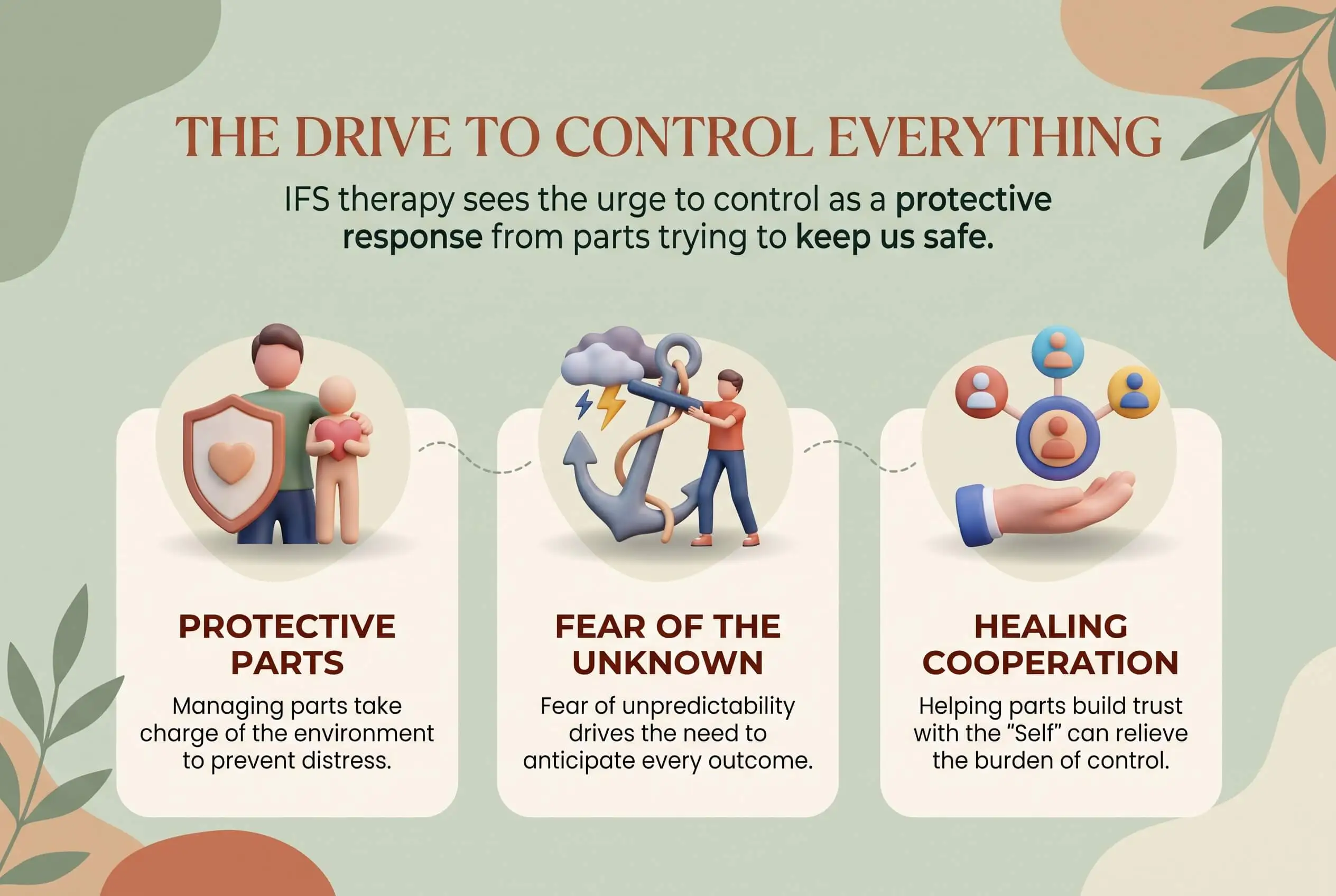
With IFS therapy explained in plain terms, that urge has a fairly ordinary source. Internal Family Systems would say a protective part of you, which it calls a manager, took on the job of keeping things from going wrong a long time ago. It's still at it, and nobody ever told it that it could stop.
I'd get to know that part before trying to get rid of it.
TL;DR Quick Answers
IFS Therapy Explained
Internal Family Systems sees the need to control every situation as the work of a protective manager, one that took charge long ago to keep an older fear from surfacing. IFS helps you get curious about that part instead of fighting it, so it can finally ease off.
Here's the shape of it:
What control is. A manager is doing a protective job, not a flaw in your character.
Where it comes from. Usually an exile, a younger part still carrying fear or shame.
What IFS does with it. You notice the part, ask what it's afraid of, and let it set the pace.
Who it tends to help. Planners, perfectionists, and anyone who finds rest strangely hard to come by.
Top Takeaways
Control Usually Has A Job. In IFS, the urge to control most often comes from a manager working to keep you safe.
Something Older Sits Underneath. Most managers guard an exile, a younger part still holding an old fear or hurt.
Willpower Tends To Backfire. Telling the part to let go asks it to stand down without ever asking why it stood up.
Curiosity Does What Effort Can't. Asking what the part is afraid would happen often loosens it faster than pushing.
You Keep The Good Parts. Your planning and your care stay. The part carrying them just gets to rest.
What Is IFS Therapy, Explained Without The Jargon?
Internal Family Systems, or IFS, is a kind of talk therapy that sees your mind as a group of parts, each with its own job, held together by a calm, curious center it calls Self. Rather than trying to remove the difficult parts, it asks what each one has been protecting.
Richard Schwartz developed the Internal Family Systems model in the 1980s while working as a family therapist. His clients kept describing their inner lives the way you'd describe a crowded house, with one part that worries and another that wants everyone to leave it alone.
If you've been searching for "parts work," you're already in the same neighborhood.
There's a longer guide to IFS therapy explained in plain language if you want to see what a session actually involves.
Why Does Part Of You Need To Control Everything?
In IFS terms, the need to control everything usually belongs to a manager whose real concern sits underneath the meeting or the trip, in an older feeling it doesn't want you to have again.
That's why "just let go" so rarely works. A more useful question is what this part thinks would happen if you did.
Managers Keep Everything Running
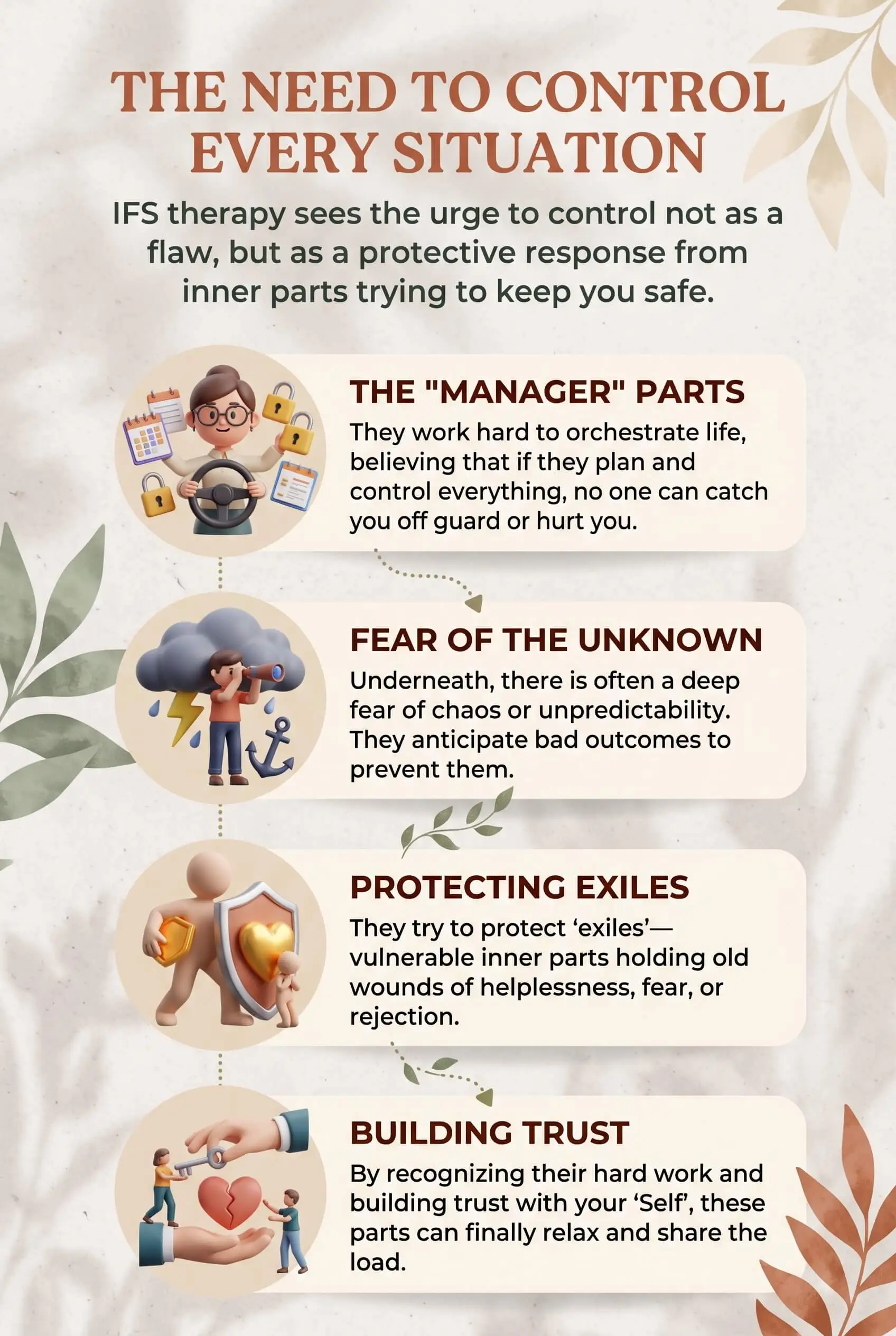
Managers run the day. They write the lists, read the room, check the email a second time and have an answer ready before anyone asks.
The inner critic is often a manager, and so is the perfectionist. Both work on the same theory, which is that if everything's handled, nothing can catch you off guard.
A lot of what managers do is useful. It's how people finish degrees and keep teams on schedule. The trouble starts when the part can't switch off, even on a quiet Saturday with nothing at stake.
Exiles Hold What The Managers Guard
Underneath most managers is a part IFS calls an exile. Exiles tend to be young, and they hold whatever felt unbearable back then, often helplessness or shame.
If life really was out of control once, a manager may have decided it would never let that happen again. Control became the wall that keeps the exile out of sight.
That doesn't mean every controlling part grew out of trauma. Plenty formed around ordinary pressure, like a house where mistakes cost something, or a job where you were the person everyone counted on.
Firefighters Show Up When Control Slips
No manager can hold every situation. When a feeling breaks through anyway, a faster kind of part takes over, and IFS calls these firefighters.
They'll put the feeling out with whatever's closest, whether that's two hours of scrolling or a sharp reply to someone you love.
Then the manager comes back, embarrassed by the mess, and tightens its grip a little more. Most people I work with recognize that loop long before they have a name for it.
Signs A Controlling Part Is Running The Show
You might recognize a few of these:
You over-prepare for meetings and trips, then feel drained before they start.
Handing something off feels harder than just doing it yourself.
You rehearse what you'll say, and later replay what you said.
A change of plans lands in your body as tension.
You need to know how something ends before you can relax into it.
You feel responsible for the mood of every room you're in.
Rest feels like something you have to earn.
None of these adds up to a diagnosis, though together they can point to a part that's carrying more than its share.
How IFS Works With A Controlling Part Instead Of Fighting It
Most advice about control comes down to effort, usually some version of "just let go." If effort worked, you'd have sorted this out years ago.
Willpower asks the controlling part to stand down without asking why it stood up in the first place. That may be part of why outside motivation tends to fade when nothing underneath has shifted.
IFS comes at it from the other side. Roughly, the work looks like this:
Notice the part. Where do you feel it? A tight jaw, a busy mind, a hand already reaching for the phone.
Step back from it a little. "I need this to go perfectly" becomes "a part of me needs this to go perfectly." That small gap matters more than it looks.
Get curious. Ask the part what it's trying to do for you, and listen without arguing.
Ask what it's afraid of. What does it believe would happen if it stopped? The answer is usually old and surprisingly specific.
Let it set the pace. If it says not yet, that's information.
Meet what it protects. With a trained therapist, and only with the manager's permission, the work can reach the exile underneath. Once that younger part feels heard, the manager often relaxes without being asked.
Nothing gets forced, and the controlling part doesn't have to leave. It just takes the clipboard down for a while.
"In sessions, the part that needs to control everything is usually the hardest-working part in the room, and by the time someone finds their way to me it's worn out. When we stop trying to override it and ask what it's afraid of, it nearly always answers with something old, often a particular year when nobody was steering. Once that's been heard, I rarely have to ask it to loosen its grip. It does that at its own pace."
Essential Resources
If you're reading up on control and IFS, these are the places I'd send you next. All of them are public and free, and none of them are trying to sell you anything.
1. Start With The Neutral Overview
Wikipedia lays out where Internal Family Systems came from and how it describes parts and Self. It's a good first stop if you like seeing the whole picture before deciding anything.
Source: Wikipedia — Internal Family Systems Model
2. Hear How The Model Describes Itself
The IFS Institute, which Richard Schwartz founded, explains the model in its own words, including the eight qualities it links to Self. It's also upfront that the research base is still small, which I respect.
Source: IFS Institute — What Is Internal Family Systems?
3. Find Where Everyday Worry Ends
The National Institute of Mental Health draws a clear line between ordinary anxiety and an anxiety disorder that doesn't ease up. If your controlling part runs on worry, this helps you judge how much is too much.
Source: NIMH — Anxiety Disorders
4. Read A Calm Guide To Anxiety
MedlinePlus, from the National Library of Medicine, covers what anxiety feels like in the body and what treatment usually involves. It's short and plain, and easy to pass along to someone you love.
Source: MedlinePlus — Anxiety
5. Know What To Ask A Therapist
NIMH lists the questions worth putting to any therapist before you start, including what approach they use and what happens if you aren't getting better. Controlling parts tend to be like a good checklist, and this is one.
Source: NIMH — Psychotherapies
6. Understand How Talk Therapy Works
The American Psychological Association walks through what happens in therapy and why the relationship with your therapist matters so much. It notes that some people start feeling better in six to 12 sessions.
Source: APA — Understanding Psychotherapy and How It Works
7. Learn What Safe Care Should Feel Like
SAMHSA sets out the principles a trauma-informed provider is meant to practice, safety and choice among them. Worth reading before you sit down with anyone, IFS therapist or not.
Source: SAMHSA — Trauma-Informed Approaches and Programs
Supporting Statistics
A few numbers I keep coming back to when people ask why letting go feels so hard.
1. Perfectionism Has Been Rising For Decades
Thomas Curran and Andrew Hill pooled 164 samples covering 41,641 American, Canadian and British college students who completed the same perfectionism scale between 1989 and 2016.
Every type of perfectionism they measured went up over that period.
Their 2026 follow-up, covering 82,939 students, found that the sense of other people demanding perfection from you has been accelerating since the early 2000s.
What I notice: the fastest-growing kind comes from outside. That's the manager part listening very closely to everyone else.
Sources: University of Bath — Perfectionism Is Increasing Over Time (2019) and York St John University — Perfectionism Is Accelerating Over Time (2026)
2. Anxiety Is More Common Than It Looks
NIMH estimates that 19.1% of U.S. adults had an anxiety disorder in the past year, based on the National Comorbidity Survey Replication.
About 31.1% will have one at some point in their lives.
Women reported higher past-year rates than men, 23.4% compared with 14.3%.
What I notice: a lot of controlling behavior is anxiety in a good suit. From the outside it reads as competence, so hardly anyone thinks to ask how the person is doing.
Source: NIMH — Any Anxiety Disorder
3. The IFS Research Is Promising And Still Young
In a 2025 pilot of a 12-week online group IFS program for adults with PTSD and substance use, participants rated acceptability at 86%.
92% said they'd refer a friend, and 70% were still enrolled at 12 weeks.
The authors call it a small pilot and say a larger randomized trial is needed before anyone draws firm conclusions.
What I notice: people stayed. Something that feels like being pushed rarely holds anyone for 12 weeks.
Research shows that perfectionism and anxiety can make it difficult to let go of control, particularly in demanding environments such as a private school, where academic expectations and pressure to succeed may contribute to stress. While IFS therapy research remains limited, early findings suggest that its supportive approach may help people better understand the protective patterns behind their need for control.
Final Thoughts And Opinion
Thank the part that needs control before you try to change it. That sounds soft, and in practice it's one of the harder things I ask of people.
Where I've landed, after a lot of hours with this pattern:
Control was a smart move once. The part running it showed up when you needed it and hasn't taken a day off since. It deserves some credit before it gets a lecture.
My unpopular opinion. Another productivity system usually makes this worse. A better planner hands the controlling part a sharper tool and gives it no reason to rest.
Curiosity does more than effort. You can't white-knuckle your way out of a white-knuckle pattern. Asking the part what it's afraid of tends to move things that years of trying to let go didn't.
The research is still catching up. It's promising, and it's young. I'd rather you came to IFS because it makes sense to you than because someone online called it a breakthrough.
Fit matters more than method. If this way of talking about yourself doesn't land, another approach may serve you better, and that's a perfectly good outcome.
This page explains a therapy model. It can't diagnose you, and it doesn't replace care from a licensed professional who knows your history.
Most people start an IFS therapy session hoping to finally get control of their control. Usually something gentler happens during the session. The part that has been holding everything up finds out it doesn't have to do that alone anymore.
Frequently Asked Questions
Q: Why Do I Feel The Need To Control Everything?
A: In Internal Family Systems, that need usually comes from the protective manager part. Somewhere along the way it learned that staying in charge kept something painful from happening, or from being felt. The urge usually has less to do with this week's meeting or trip than with an older fear the part is still guarding.
Q: What Are Manager Parts In IFS?
A: Managers are the protectors that run your day. They plan ahead and spot problems early so nothing catches you off guard. The inner critic and the perfectionist are two of the most common. They mean well, even when their methods leave you exhausted.
Q: Is Needing Control A Trauma Response?
A: Sometimes. If life once felt truly out of control, a manager may have taken charge to make sure it never happened again. Controlling parts also form around everyday pressure, like a demanding home or a job where everything landed on you. You don't need a dramatic history for this pattern to make sense.
Q: How Does IFS Therapy Help With Control Issues?
A: Rather than trying to defeat the controlling part, IFS helps you notice it and get curious about what it fears. With a trained therapist, and at the part's own pace, the work can reach the younger part it protects. When that part feels heard, the manager often eases off on its own.
Q: Can I Work With My Controlling Part On My Own?
A: You can start. Noticing the part and asking what it's worried about are gentle things plenty of people practice between sessions. Going toward older pain is safer with a trained IFS therapist alongside you, and if the pattern is costing you sleep or relationships, I'd get that support sooner rather than later.
Q: How Is IFS Different From Just Trying To Let Go?
A: Trying to let go treats control as the problem and willpower as the fix. IFS treats control as a protector with a reason, so instead of overriding it, you ask what it needs. In my experience that takes a lot of the fight out of things, because the part no longer has to struggle to be heard.
Whenever You're Ready To Loosen The Grip
Try one small thing this week. The next time you feel the pull to take over, pause and ask that part what it's worried would happen if you didn't. You don't have to change anything yet. Listening is enough for now.
If the pattern feels heavy, or it's starting to cost you sleep or closeness, consider reaching out to a therapist trained in IFS. Access to mental health support is an important part of health and wellness as fundamental human rights. Reaching out takes more than people admit, and a short first conversation is plenty to begin with.