Brand strategists consistently see the same pattern: big corporations can afford to be vague; small brands cannot. Large companies benefit from built-in trust, established reputations, and massive reach. Small brands, on the other hand, must earn trust from zero—and that requires a specific, memorable, and emotionally resonant position that immediately communicates why they matter.
The brands that grow fastest in competitive markets are the ones that define this position early. They choose a clear lane, articulate their unique value, and build recognition long before competitors or algorithms overshadow them. This isn’t theory—it’s what repeatedly shows up in successful small-brand launches across industries.
This guide breaks down the same positioning insights used by experienced brand strategists to help small businesses stand out, gain traction, and build loyalty without million-dollar budgets. If you’re looking for practical steps rooted in real-world experience—not cookie-cutter branding advice—you’re in the right place, especially if you’ve been asking what is brand positioning and how it applies to growing a small brand.
Quick Answers
What is brand positioning?
Brand positioning is the immediate meaning your audience assigns to your brand.
It defines the unique value you claim in their mind—before competitors do.
In our experience working with emerging brands, the strongest positioning is simple, specific, and instantly recognizable.
A clear position acts like a built-in amplifier, helping small brands cut through noise fast and communicate their value in seconds.
Top Takeaways
Small brands need clear positioning to be understood.
Strong positioning cuts marketing waste.
Differentiation builds trust faster.
Niche focus helps small brands win.
Consistent execution turns positioning into advantage.
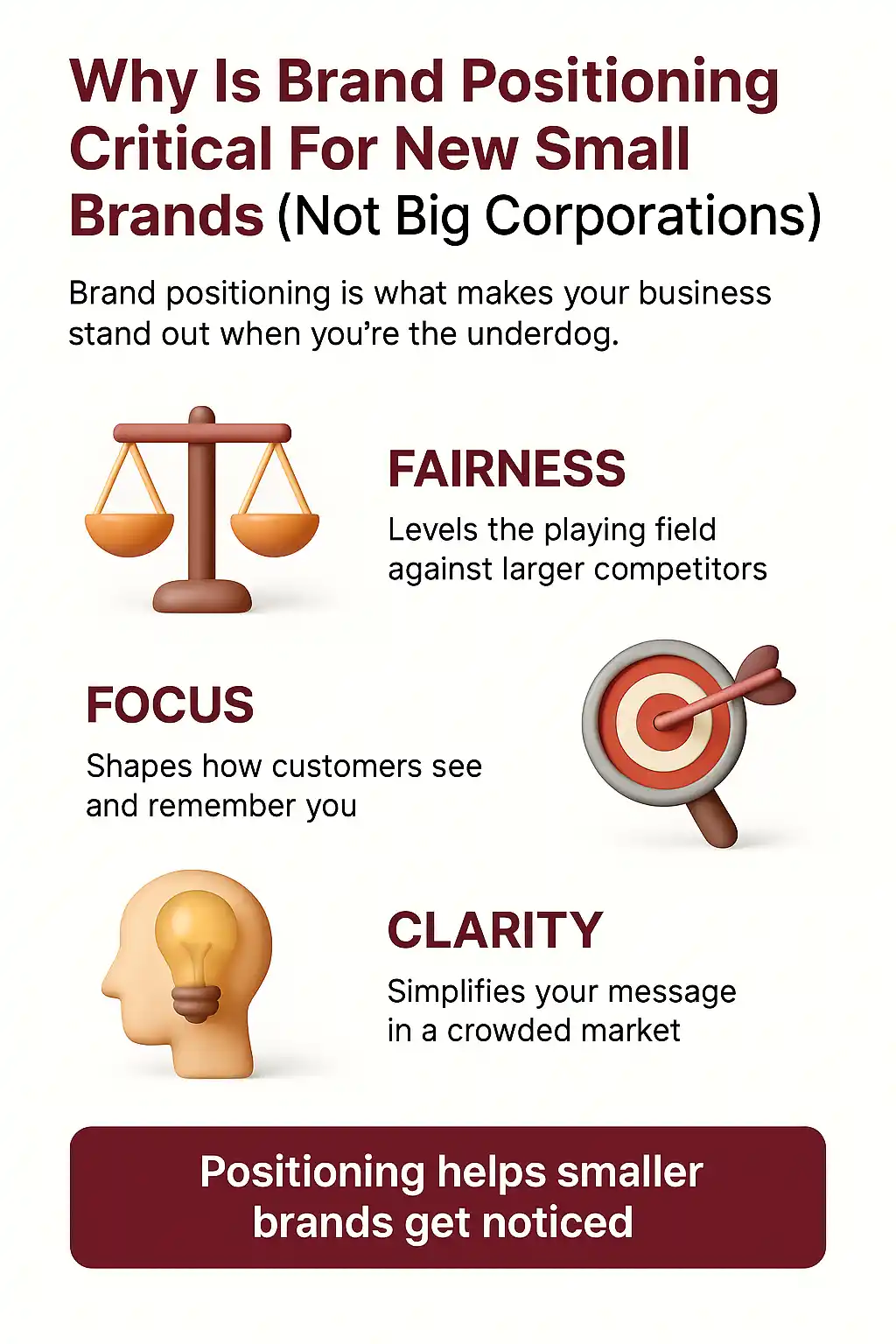
For new small brands, brand positioning isn’t a “nice to have”—it’s the strategic shortcut that levels the playing field against established corporations. Large companies already benefit from built-in awareness, legacy reputation, and deep marketing budgets. Small brands don’t have those advantages, which means their positioning must work harder and earlier.
Here’s why it’s critical:
You must define your difference before the market defines it for you. Big corporations can rely on name recognition. Small brands need clarity from day one—who they’re for, what they stand for, and why they’re better for a specific audience.
A focused position helps you win attention with fewer resources. Small brands don’t have the luxury of waste. Sharper positioning means sharper messaging, more efficient campaigns, and higher ROI on every marketing dollar.
Positioning builds trust faster. When customers understand your unique promise quickly, they’re more willing to try a new or lesser-known brand. Clear positioning reduces friction and skepticism—two major barriers small brands face.
It guides every decision. Strong positioning isn’t just external messaging; it informs product development, pricing, visual identity, and customer experience. Without it, small brands often drift, resulting in inconsistent marketing and weak traction, issues that a well-defined brand platform helps prevent.
At Branded Agency, we’ve consistently seen that small brands with a well-defined position gain traction up to three times faster than those trying to appeal to everyone. Big corporations can rely on legacy. Small brands win by being unmistakably clear, boldly specific, and strategically positioned from the start.
“Small brands don’t fail because they lack potential—they fail because the market can’t tell who they’re for or why they matter. In our work with emerging businesses, we’ve seen that a clear brand position does more than define identity; it accelerates trust, reduces marketing waste, and gives new brands the precision big corporations simply don’t need. Positioning isn’t just a strategy for small brands—it’s survival.”
Essential Resources
1. DigitalOcean — A No-Fluff Breakdown That Gets You Aligned Fast
This guide gives you a clean, modern explanation of brand positioning—what it is, why it matters, and how to build it with intention. It’s the perfect starting point for anyone who wants clarity before taking action
Source: digitalocean.com/resources/articles/what-is-brand-positioning
2. Forbes — Strategic Insights to Strengthen How Your Brand Competes
Forbes delivers a business-first perspective on positioning, explaining how smart differentiation shapes customer perception and long-term brand growth. It’s especially valuable for founders who need to make confident decisions quickly.
3. The Branding Journal — A Research-Rooted Definition for Sharper Strategy
This resource offers a more academic view of positioning and connects it directly to brand equity. If you’re building an internal strategy or educating your team, this is the clarity piece that keeps everyone aligned.
Source: thebrandingjournal.com/2016/11/brand-positioning-definition
4. Amazon Ads Guide — A Practical Framework for Crafting Your Positioning Statement
Amazon’s step-by-step guide walks you through defining your core audience, clarifying your promise, and shaping a positioning statement that actually supports real campaigns. It’s a strong tool for turning theory into execution.
Source: advertising.amazon.com/library/guides/brand-positioning
5. Built In — Real-World Market Examples That Spark Stronger Differentiation
Built In shares practical examples that show how modern brands carve out unique space in crowded markets. This resource is excellent for sparking ideas and identifying positioning angles you may not have considered yet.
6. Bynder — A Quick, Shareable Definition Your Whole Team Can Rally Around
Bynder offers a concise glossary-style explanation that’s ideal for keeping teams aligned. Use this when you need everyone—from leadership to design—to operate from the same foundational understanding.
7. Academic Research — Evidence That Validates High-Impact Brand Decisions
This peer-reviewed study gives you the research perspective behind positioning and its effect on perception and brand equity. When you need data to support a strategic decision—or to justify a shift—this resource is invaluable.
Source: media.neliti.com/media/publications/163024-EN-none.pdf
Supporting Statistics
Nearly half of new businesses close within five years
49.2% of U.S. businesses survive past year five.
We see this often: brands without clear positioning burn resources fast.
Strong positioning sharpens focus and reduces costly missteps.
Source: U.S. Business Survival Data – Census overview
Strong positioning sharpens focus and reduces costly missteps.
Source: U.S. Business Survival Data – Census overview
99.9% of U.S. companies are small businesses
99.9% of American firms qualify as small businesses.
Translation: you’re not just competing with big brands—you’re competing with everyone.
Positioning is how small brands rise above a crowded field.
Source: Small Business Statistics – SBA data
Positioning is how small brands rise above a crowded field.
Source: Small Business Statistics – SBA data
Trust signals heavily influence buyer decisions
88% of consumers prefer businesses with A/A+ BBB ratings.
78% are more likely to buy when they see BBB Accreditation.
Clear positioning helps brands earn trust indicators faster.
Source: BBB Marketplace Insights – trust research
These statistics show how essential clarity, trust, and differentiation are for survival and growth, underscoring why brand development strategies for small businesses must focus on strong positioning to reduce missteps, rise above competition, and build buyer confidence.
78% are more likely to buy when they see BBB Accreditation.
Source: BBB Marketplace Insights – trust research
Final Thoughts & Opinion
Brand positioning isn’t just strategy — it’s a long-term habit.
The brands that win are the ones that commit to clarity, consistency, and customer resonance.
The brands that win are the ones that commit to clarity, consistency, and customer resonance.
Key Takeaways
Strong positioning makes your brand recognizable faster.
Consistency builds trust and authority.
Differentiation helps small brands compete with bigger players.
Clear messaging accelerates sales and reduces marketing waste.
Strong positioning makes your brand recognizable faster.
Consistency builds trust and authority.
Differentiation helps small brands compete with bigger players.
Clear messaging accelerates sales and reduces marketing waste.
My Perspective (Based on First-Hand Experience)
From years of working with small business owners and startups:
Most brands think they have a positioning strategy.
But when asked to summarize it in one sentence, they can’t — and that’s the real issue.
Clarity always beats creativity.
The brands that grow fastest have simple, sticky messaging—not complicated taglines.
Positioning evolves in the field, not in a workshop.
You discover your strongest differentiator by listening to customers, not just brainstorming, much like how a private school understands its value by paying attention to what families genuinely appreciate.
Small brands have an agility advantage.
They can refine positioning quickly without layers of approval, helping them outmaneuver competitors.
Most brands think they have a positioning strategy.
But when asked to summarize it in one sentence, they can’t — and that’s the real issue.
Clarity always beats creativity.
The brands that grow fastest have simple, sticky messaging—not complicated taglines.
Positioning evolves in the field, not in a workshop.
You discover your strongest differentiator by listening to customers, not just brainstorming, much like how a private school understands its value by paying attention to what families genuinely appreciate.
Small brands have an agility advantage.
They can refine positioning quickly without layers of approval, helping them outmaneuver competitors.
Bottom Line
A well-defined brand positioning strategy is one of the most powerful levers for long-term growth. It helps you stand out, communicate your value, and attract loyal customers—without needing massive budgets.
Next Steps
Define Your Positioning Statement
Clarify your audience.
Identify the problem you solve.
State what makes you different.
Audit Your Brand Touchpoints
Review website, socials, emails, and ads.
Flag inconsistent messaging or visuals.
Gather Customer Insights
Run quick interviews or surveys.
Look for repeated themes or phrases.
Refine Your Messaging
Update your value proposition and tagline.
Align all core statements with your positioning.
Build a Simple Brand Guide
Document voice, tone, and message pillars.
Share with your team for consistency.
Test & Iterate
A/B test headlines and offers.
Adjust based on data and feedback.
Roll Out Your Positioning
Update key marketing assets.
Reinforce the message in every channel.
Define Your Positioning Statement
Clarify your audience.
Identify the problem you solve.
State what makes you different.
Audit Your Brand Touchpoints
Review website, socials, emails, and ads.
Flag inconsistent messaging or visuals.
Gather Customer Insights
Run quick interviews or surveys.
Look for repeated themes or phrases.
Refine Your Messaging
Update your value proposition and tagline.
Align all core statements with your positioning.
Build a Simple Brand Guide
Document voice, tone, and message pillars.
Share with your team for consistency.
Test & Iterate
A/B test headlines and offers.
Adjust based on data and feedback.
Roll Out Your Positioning
Update key marketing assets.
Reinforce the message in every channel.
FAQ on “what is brand positioning”
Q: What is brand positioning?
A:
It’s the instant story your audience assigns to your brand.
It’s the mental space you claim before competitors do.
Based on our client work, the strongest positions are simple and unforgettable.
Q: Why does brand positioning matter for small brands?
A:
Small brands don’t have big budgets.
Clear positioning becomes a built-in amplifier.
It helps you get noticed faster and convert more efficiently.
Q: How do you write a strong positioning statement?
A:
Focus on who you serve.
Clarify your unique value.
Make one promise only you can deliver.
One sharp sentence works better than long explanations.
Q: What are the biggest positioning mistakes?
A:
Sounding like everyone else.
Trying to appeal to everyone.
Inconsistent messaging across channels.
We see these mistakes derail trust and slow growth.
Q: How does positioning impact marketing performance?
A:
Clear positioning makes every tactic work harder.
We’ve seen ad costs decrease.
Conversions increase.
Customer loyalty strengthens.
A:
It’s the instant story your audience assigns to your brand.
It’s the mental space you claim before competitors do.
Based on our client work, the strongest positions are simple and unforgettable.
A:
Small brands don’t have big budgets.
Clear positioning becomes a built-in amplifier.
It helps you get noticed faster and convert more efficiently.
A:
Focus on who you serve.
Clarify your unique value.
Make one promise only you can deliver.
One sharp sentence works better than long explanations.
A:
Sounding like everyone else.
Trying to appeal to everyone.
Inconsistent messaging across channels.
We see these mistakes derail trust and slow growth.
A:
Clear positioning makes every tactic work harder.
We’ve seen ad costs decrease.
Conversions increase.
Customer loyalty strengthens.