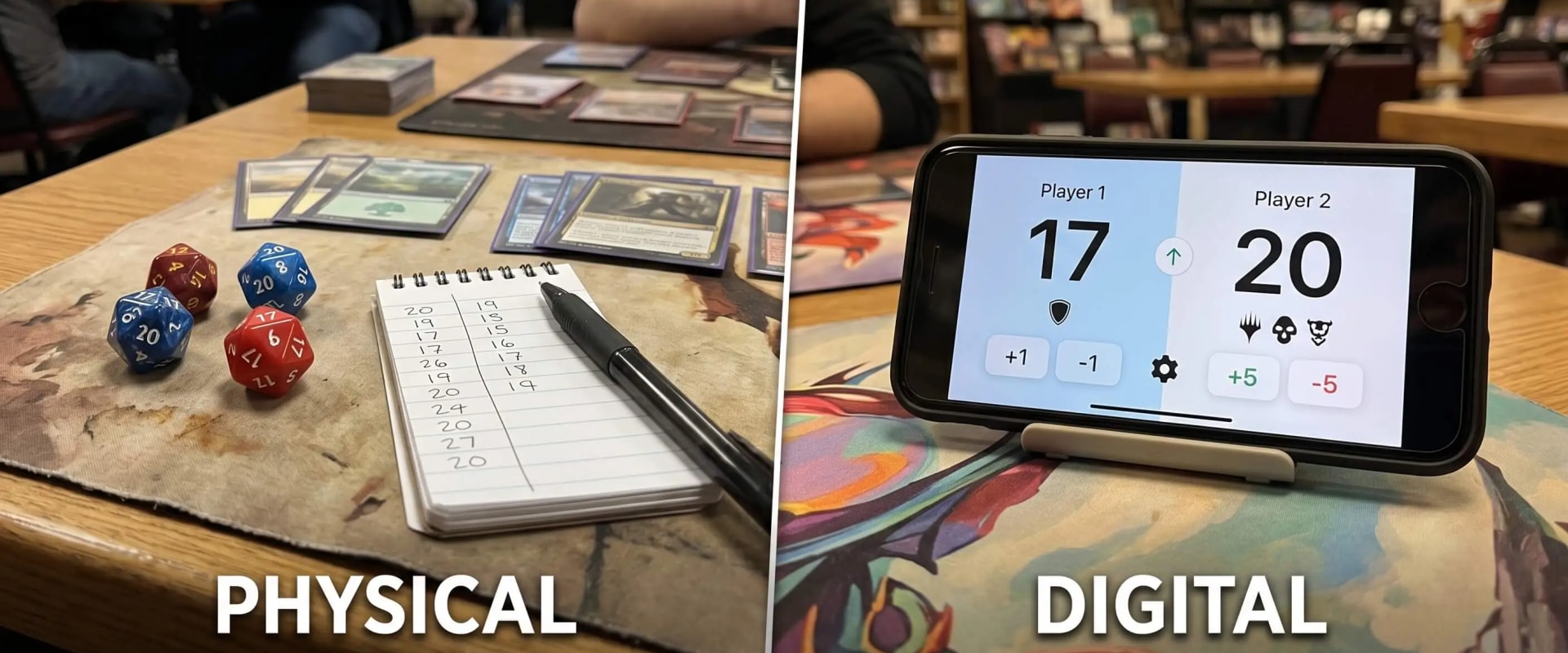
That moment is why this question keeps coming up at every kitchen table and local game store: should you use an MTG life counter app or stick with physical dice? The short answer is that an app wins on speed and accuracy, but dice still earn a place in plenty of games. If you play Magic: The Gathering at all, the right tracker can change how smoothly your matches run.
TL;DR Quick Answers
Magic: The Gathering (MTG) Digital Life Counter App vs Physical
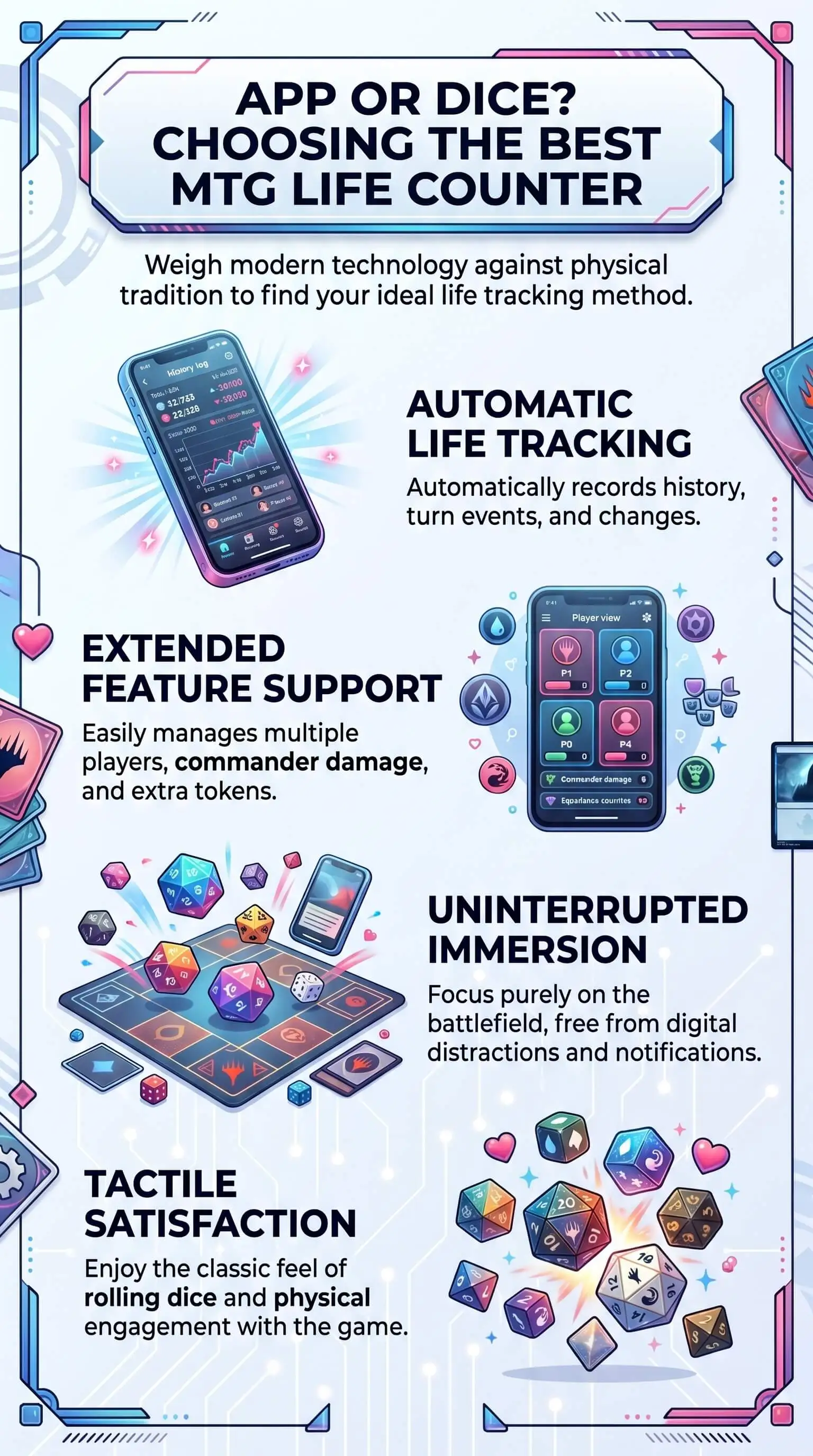
A digital MTG life counter app wins for most players because it's faster, more accurate, and handles multiplayer Commander stats that a physical die can't display on one device. Physical counters (dice, dials, wheels) still earn a place for casual two-player matches, tactile players, and games where phone notifications would break focus.
Speed: Tapping a screen beats rotating a spindown across 40+ life changes in a Commander match.
Accuracy: Bumped tables don't change app scores when the app requires a confirmation tap before each adjustment.
Tracking depth: One screen shows life, commander damage, poison, and energy for every player at once.
Convenience: Your phone's already in your pocket. Your dice bag is at home.
Tradeoffs: Phones can drain battery and ping with notifications. Dice avoid both.
Best for tournaments: A digital tracker is usually required to log wins and losses on the event platform. Best for casual two-player Magic: Either works, and many players mix both.
Top Takeaways
Speed favors the app. Accuracy favors the app. Mood and aesthetics favor the dice.
Commander multiplayer is where physical dice break down hardest, because a single pod can need four or five life totals tracked at once.
A free life counter app removes the cost barrier to trying digital before committing to anything paid.
A confirmation-step app eliminates the bump-the-table accident that ruins physical scorekeeping.
How Fast Can You Actually Play With Dice?
Dice look fast. They're sitting right there, ready to go. But once a real game starts, the gap between an app and a spindown shows up quickly.
Subtract three from 20 on a spindown, and you're rotating the die through three faces while making sure you don't bump it past 17. Tap a screen three times, and you're done. Multiply that by every life change across a 40-turn Commander match, and the time difference adds up.
The deeper problem is mental load. A die tells you the current number. An app remembers what the number was a turn ago, two turns ago, the whole game. When someone asks whether they took six from your commander last turn, you have an answer instead of a guess.
Where dice still win on speed is in two-player casual matches with simple math. Starting at 20, taking a couple of hits per turn, finishing in 10 minutes. For that kind of game, dice are fine. The slowdown only shows up once tracking gets complicated.
Where Accuracy Falls Apart
Every physical counter has the same weakness: it can be moved by something other than the player who owns it. A cat walks across the table. A friend reaches for a pretzel. Someone slides a card into play and brushes the die. Now the score is wrong, and nobody knows what the right number was.
Apps don't have this problem if they're designed well. The best ones require a confirmation tap before a number changes, which removes the accidental-bump issue entirely. For a side-by-side breakdown of how each tracker category handles this, the full guide to magic the gathering mtg digital life counter app vs physical options walks through every option in detail.
Accuracy also matters when you're tracking more than just life. Commander adds commander damage from each opponent, plus poison counters, plus energy, plus whatever else a deck cares about. A pile of dice and tokens trying to represent all of that across four players turns into a mess fast. One screen handles the same load without any organizational gymnastics.
Convenience and the Multiplayer Problem
This is where the conversation usually ends, because the convenience gap is huge. Your phone is in your pocket already. Your dice bag is on the shelf at home.
If you've ever shown up to Friday Night Magic without your tracker, you know how annoying it is to borrow one or improvise with a notepad. An app on your phone solves that. You can sit down at any game in any city and have your life counter ready in two seconds.
Multiplayer is the bigger issue. Commander pods of three, four, and five players need every player's life total visible at the same time. One die sitting in front of each player works, but it forces everyone to lean over and squint across the table. A phone in the middle, or each player's own screen showing the same shared totals, makes everyone's status visible at a glance.
The honest downsides of using a phone are real. Battery drain matters during long sessions. Notifications can pull you out of the game. Some people simply enjoy holding a die more than tapping glass. None of those are small concerns, and the right choice depends on which tradeoff bothers you less.
“We asked a Friday Night Magic organizer at a central Florida game store how often the dice-versus-app debate comes up at his tables during a typical Magic the gathering life counter discussion. His response: “Once you're running a Commander pod with three or four players, a phone-based tracker isn't just convenient. It's the difference between finishing the match before midnight and arguing over what someone's life total was two turns ago.”
7 Essential Resources
These are the resources we lean on most when explaining the dice-versus-app question to new players:
Magic: The Gathering on Wikipedia. The clearest overview of the game's history, formats, and rules.
Magic: The Gathering official site. Direct from Wizards of the Coast for set releases, rules updates, and tournament news.
Magic: The Gathering Comprehensive Rules. The official rulebook for anyone resolving an edge-case ruling.
EDHREC. The most-used statistics site for Commander deck building and format trends.
r/magicTCG on Reddit. The largest active MTG community for discussion, news, and gear recommendations.
Commander Rules Committee. The official source for Commander format rules and the banned list.
MatchPunk. A free MTG life counter app built around accurate score tracking, win-loss records, and event management.
3 Statistics
Magic: The Gathering has more than 50 million total players globally, a figure cited by Hasbro and tracked across MTG Arena registrations and tabletop estimates. Source.
42.8% of MTG players list Commander as their favorite format, the highest share of any format by a wide margin, per the most recent MTG Play Activity Report. Source.
Total Magic: The Gathering revenue reached $1.72 billion in FY 2025 across tabletop and digital expressions, reflecting the brand's continued growth as Hasbro's largest gaming property and a major success story in modern brand marketing campaign strategy. Source.
Final Thoughts and Opinion
After comparing both options across speed, accuracy, and convenience, our take is straightforward. An MTG life counter app wins for most players, most of the time. The speed advantage is real, the accuracy advantage is bigger, and the convenience of carrying one in your pocket settles it. Commander, with its multiplayer life totals and stacked tracking demands, especially favors a digital tool.
That said, we'd never tell someone to throw out a beautiful set of spindown dice. A well-made physical counter is part of the experience for plenty of players, especially in organized communities and competitive environments that sometimes resemble the structure of private schools in how they emphasize rules, accuracy, and consistency. The smart move is to keep dice for casual matches and use an app when accuracy actually matters.
Frequently Asked Questions
Is an MTG life counter app actually faster than using dice?
Yes, for any game with frequent life changes. Tapping a number is faster than rotating a spindown die, and the gap widens in Commander pods where life totals shift on nearly every turn.
Can I use a free MTG life counter app, or do I need to pay?
Plenty of free options exist on both Google Play and the Apple App Store. Free apps cover basic life tracking well. Paid versions add features like win-loss records, event hosting, and custom themes.
Are physical dice allowed in MTG tournaments?
Yes, dice are allowed for casual play and most sanctioned events. However, many tournament organizers ask players to use a digital tracker so wins, losses, and matches can be recorded by the event platform.
What's the difference between a spindown die and a regular d20?
A spindown die has its numbers arranged sequentially, so the next-highest and next-lowest numbers sit on adjacent faces. A regular d20 scrambles its numbers for fair rolling and isn't designed for life tracking.
Which is better for Commander, dice or an app?
An app is the better choice for Commander in most situations. Commander tracks life totals, commander damage from each opponent, and often poison counters or energy. A single screen handles all of that more cleanly than a pile of dice.
Does using a phone during MTG drain my battery quickly?
Some apps drain more than others. A well-built life counter app uses minimal background resources. A 90-minute Commander game typically uses 3% to 8% of phone battery on most modern devices.
Can I use both an app and dice in the same game?
Yes, plenty of players track main life totals on an app and use dice or tokens for things like +1/+1 counters and poison. Mixing the two is common at competitive tables.
CTA
Before your next match, download a free MTG life counter app and try it for one game. The first time you don't lose track of life totals across four players, you'll know which side of the dice-versus-app debate you land on — and why digital tracking has quietly become part of the broader brand strategy behind modern tabletop gaming experiences.